While it is often stated that there is no direct correlation between acid number and machinery problems, the acid number can still serve as a useful indicator that further fuel quality assessment may be warranted. When the acid number of a fuel sample is within the ISO 8217 specification but is higher than the historical average for the port of bunkering, it is recommended to closely monitor the performance of the fuel handling system, particularly fuel pumps and purifiers, when the fuel is put into use to ensure there are no adverse operational effects.
In some cases, further investigation of the fuel’s chemical composition using techniques such as GC-MS may be beneficial. Such detailed chemical
characterization can provide a more comprehensive assessment of fuel quality and help identify potential contaminants or degradation products that may present operational risks.
The most benign cause of an elevated acid number for operating conditions for ships may result from the presence of naphthenic crude components. Based on historical observations in shipping, fuels derived from naphthenic crude sources have generally not resulted in operational problems, even when the acid number is relatively high. This is often reflected in the historical average of the acid number of the port.
When elevated acid numbers are associated with organic acids not originating from naphthenic crude sources, the risk profile changes significantly. For example, cases involving elevated acid numbers together with increased levels of phenols, oxygenated compounds, or free fatty acids (FFA) have shown a much higher likelihood of machinery related problems onboard.
Problem fuel cases and acid number trends:
In several serious problem cases observed over recent years, acid numbers have proven to be a useful and early fingerprint parameter. Problematic samples frequently showed acid numbers that were slightly elevated and above the typical port average. While an elevated acid number does not automatically mean that the fuel will cause problems, it can serve as a valuable screening and trending parameter when assessing fuel risks.
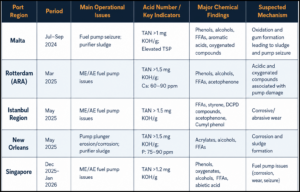
Examples of such cases are provided below.
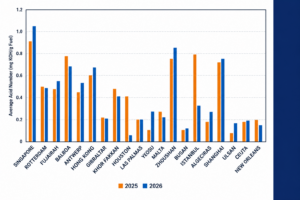
Comparison of Average Acid Number Across Major Ports: 2025 vs 2026
The figure below shows the average acid number for 2025 and 2026 across the top 20 major ports.
The data indicates clear regional differences in fuel acidity levels among major bunkering ports, with certain ports recording relatively high average acid numbers in both years.
Singapore showed the highest average acid number among the evaluated ports, exceeding 1 mg KOH/g fuel in 2026. Zhoushan and Shanghai also exhibited elevated average values compared to 2025. Among all samples tested in 2025, approximately 10% had an acid number higher than 1 mg KOH/g fuel.
Although elevated acid number alone does not necessarily result in operational problems, ports with consistently higher average values, particularly when unrelated to naphthenic crude sources, may represent a greater potential risk for fuel instability, chemical contamination, and operational issues.
Based on our problem fuel database, fuels with an acid number above 1.5 mg KOH/g were approximately 57 times more likely to be associated with fuel pump problem cases than fuels with an acid number ≤1.5 mg KOH/g. Therefore, continuous monitoring of acid number trends and correlation with operational feedback remain important.
Conclusion:
A common characteristic among all serious problem samples is an elevated acid number.
Although not all samples with high acid numbers result in operational problems, acid number can still be considered a useful fingerprint parameter for identifying potential risk cases.